
Van Wert Probation and Parole
Release from the Van Wert County Correctional Facility does not answer whether supervision continues. Ohio's Adult Parole Authority, known as the APA, handles parole and post-release control through the Ohio Department of Rehabilitation and Correction. Van Wert Municipal Court and the Common Pleas Court impose their own forms of probation or community control. The releasing jail does not turn those separate court and state tracks into one record.
The key is the sentence. Parole is conditional release from an eligible prison sentence before the sentence is fully discharged. Post-release control is a period of APA supervision that follows certain Ohio prison terms. Probation or community control lets a court supervise a person in the community under its judgment. Bond is different again. It permits release while a case proceeds and may carry court-set terms without being parole.
| Supervision track | Who orders it | Best public check |
|---|---|---|
| Parole | Ohio Parole Board under state law | ODRC Offender Search and the individual hearing fields |
| Post-release control | Required or authorized with an Ohio prison sentence | ODRC status, supervision dates, conditions, and APA Offices fields |
| Probation or community control | Van Wert sentencing court | The court docket and its probation department |
| Bond conditions | Court handling the pending case | Current docket entries and a verified court copy |
- Parole
- Conditional release from an eligible prison sentence under APA control.
- Probation
- Court-ordered community supervision, often called community control in Ohio.
- Post-release control
- APA supervision that follows certain prison terms.
- Discharge
- The formal end of a particular sentence, supervision term, or program status.
- Absconder
- A person whom the supervising agency alleges has left supervision and whose current location is unknown.
Verify Van Wert Post-Release Supervision
The official ODRC Offender Search is the public starting point for a person who served an Ohio prison term or may be under APA control. It is not a complete list of people released from the county jail. Someone who posted bond, finished a local jail sentence, or received municipal probation without entering state prison may have no ODRC record.
- Search by first and last name or by the prefixed six-digit offender number. Use fewer fields first so a spelling difference does not hide a match.
- Run the search with Status set to APA Supervision. Search Released and Violators at Large separately when the facts call for those states.
- Use County of Commitment as Van Wert to identify a sentencing link. Use Residential County as Van Wert only when looking for an APA-supervised person reported as living there.
- Open the matched record. Compare name, offender number, docket, supervision start, period, expiration, Post Release Control, Conditions of Supervision, and APA Offices.
- For local probation, match the case to Van Wert Municipal Court or Common Pleas Court and contact that court's probation or clerk channel.
County of Commitment and Residential County mean different things. Neither field alone identifies the assigned office. Official Van Wert commitment examples have shown one record tied to LIMA 3 with Allen County residence and another tied to DEFIANCE 1 with Henry County residence. The person-specific APA Offices field is the sound routing clue. Confirm identity with the offender number and docket before drawing a conclusion.
The Van Wert County released-inmate search explains how to reconcile a county release record with a court docket when the person never entered ODRC custody.
Note: A person absent from the current jail view may be released, transferred, or moved to state custody, so roster absence is not proof.
Van Wert Probation Office Routes
No single APA address was verified as the office for every Van Wert County supervisee. ODRC assigns state supervision from the facts of the individual record, and the displayed APA Offices entry should guide contact. Local municipal probation has a direct court channel. Felony community-control questions belong with the Common Pleas case and its supervising office, not the Municipal Court merely because both are in Van Wert.
Van Wert Municipal Court Probation Department
Address:
102 E. Main St.
Van Wert, OH 45891
Probation: 419-238-5760
Court: 419-238-5767
Hours: Monday through Friday, 8 a.m. to 4 p.m.
For state parole or post-release control, open the ODRC record and use its APA Offices entry. For a municipal matter, the Municipal Court contact page supplies the probation number. A court record can establish the order and later action, while the probation department can address its own supervision record within the limits of public access.
Van Wert Parole Conditions
Conditions are the rules a supervised person must follow. Under Ohio Administrative Code 5120:1-1-12, APA releasees must obey laws and department orders, get written permission before leaving Ohio, avoid weapon possession, and follow restrictions on contact with correctional facilities. Special conditions vary. The signed written notice and the supervising officer, not a general web summary, control the exact duties in a given case.
A suspected violation can lead to agency action, but a violation allegation is not a new conviction. ODRC's Violators at Large status means the APA alleges a violation and seeks the person. ODRC also warns that it does not know an absconder's current location. Any address displayed is the last recorded address before that status and must not be treated as current.
The post-release control statute sets the legal framework and ranges for covered offenses, but the controlling version and judgment entry matter. Current general ranges vary by felony level and offense type. The public summary should be compared with the sentence and the releasee's written terms before stating when supervision ends.
Ohio VINE can issue ODRC notices for parole revocation and return to prison, release from parole, and certain hearing or transitional-control events. A notice documents the event reported by ODRC. It does not replace the offender record, the supervising office, or the court docket.
Van Wert Probation Warrant Check
Van Wert Municipal Court maintains a separate active-warrant report. It displays defendant, birth date, issue date, and case number, with sorting options. A warrant record is not a release record and does not prove that a person is now in jail. It is a distinct status check because completing one custodial stay does not resolve every case or warrant.
The official warrant page warns that its data may lag by up to 24 hours and directs law enforcement to validate the entry with the court before taking action. Readers should likewise confirm a name match and case number with the court. A warrant may relate to a municipal case, while an ODRC Violators at Large result relates to alleged state-supervision noncompliance. Do not merge the two.
The official court source shows the fields and its timing warning. The image below is a snapshot of that Van Wert Municipal Court warrant channel.
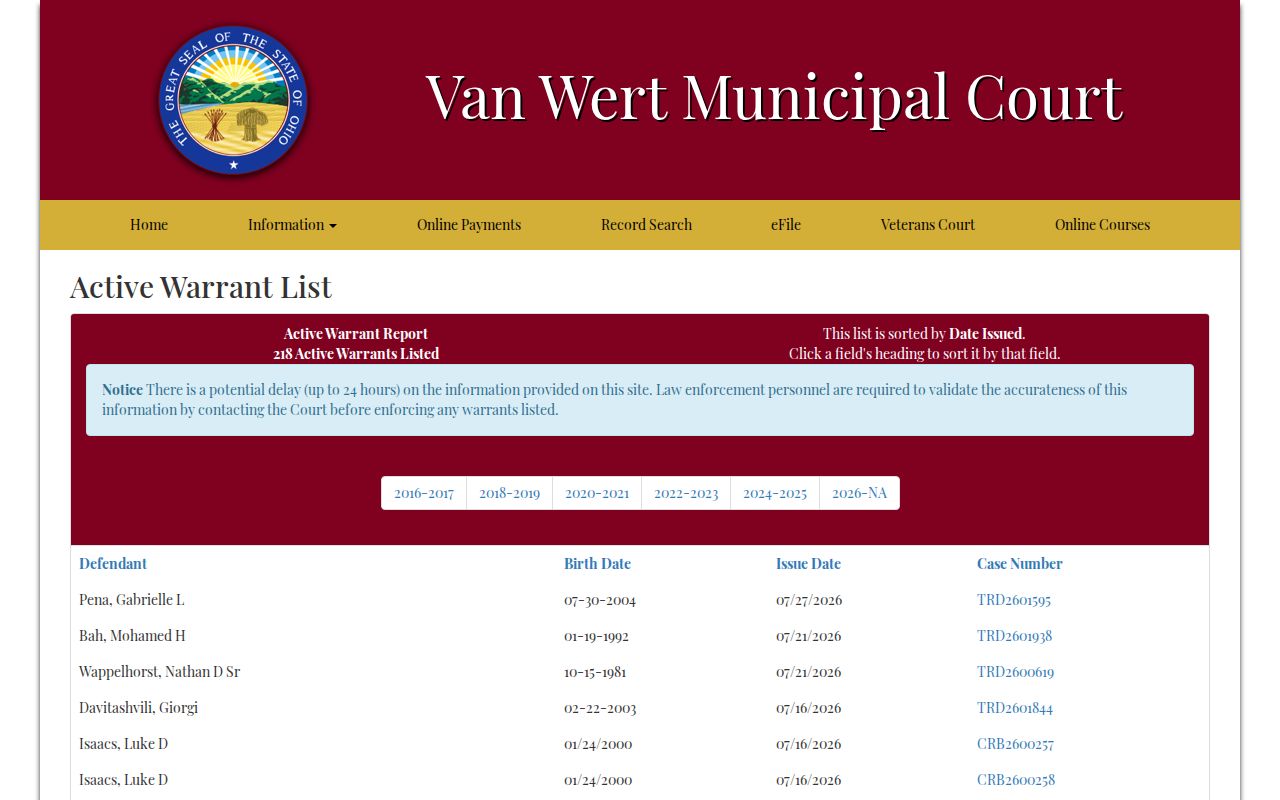
Use the live report and court confirmation because a saved image cannot show a later change.
Van Wert Veterans Court Supervision
Van Wert Municipal Court operates a Veterans Treatment Court for eligible people with pending Municipal Court charges. This is a specialized docket, not a general parole office and not a list of released inmates. Its team can include the judge, probation, a Veterans Justice Outreach Coordinator, Westwood Behavioral, and county veterans-service representation.
The program's supervision may include reporting, electronic monitoring, probation or community-control responses, and possible jail periods. Its labels for successful, neutral, unsuccessful, or voluntary opt-out discharge refer to leaving the treatment-court program. They do not necessarily mean release from physical custody or final discharge from every court obligation.
The official Veterans Treatment Court FAQ documents this local layer and its discharge terms.
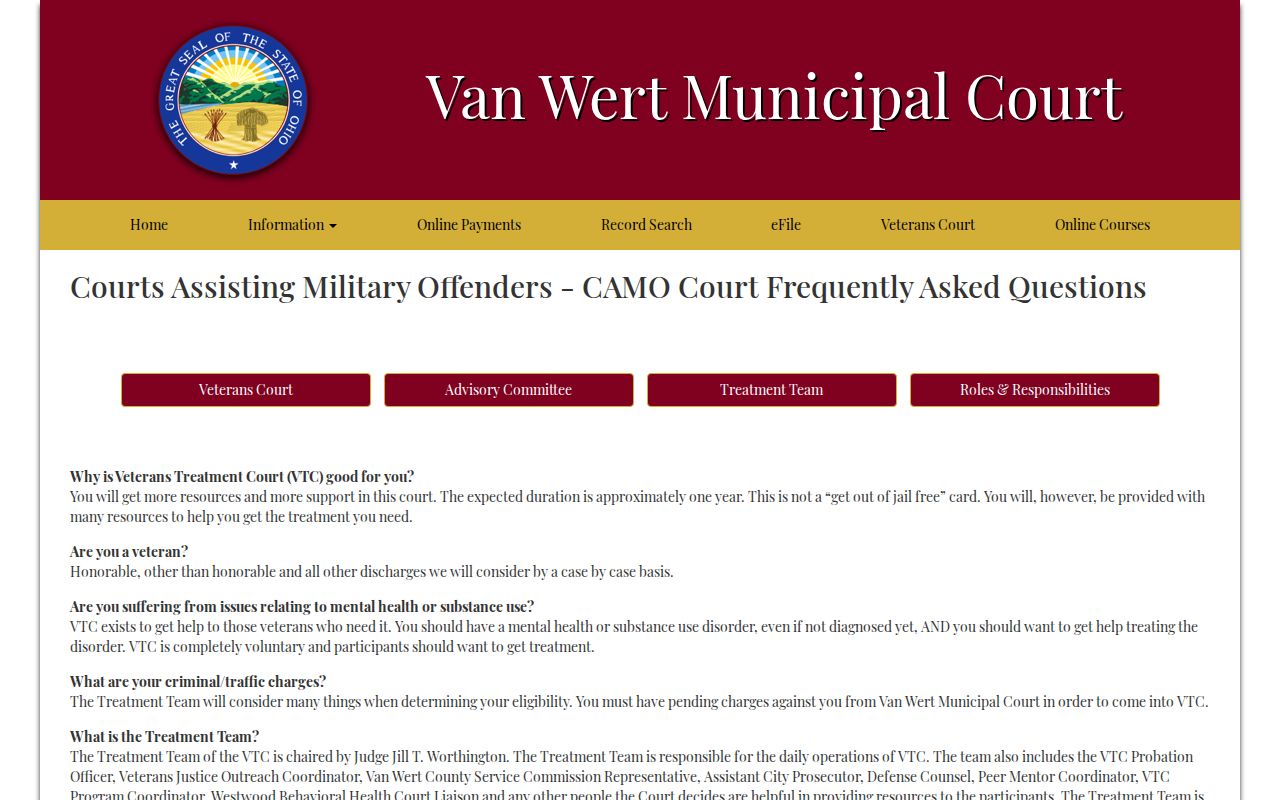
The matched case docket and probation contact remain necessary to determine what a program outcome means for one participant.
Van Wert Parole Hearing Records
Parole eligibility is not parole approval. ODRC includes a Next Parole Board Hearing Date search in YYYYMM format. An individual record can show the next hearing or review month and the latest type and result. No separate current day-by-day public calendar was verified, so scheduled information should be rechecked in the live offender record.
Result labels also require care. CONTINUED HEARING means the matter continues, not that release was granted. FULL BOARD /PAROLE, TC REVIEW/TC DENIED, and TC RECOMMENDED describe different steps. Transitional control is a controlled placement and is not the same as traditional parole or unconditional discharge. Under OAC 5120:1-1-11, release-consideration decisions are recorded in official minutes and specified notices follow a denial or continuance.
A Van Wert commitment example in the research shows a future hearing month with a continued result while the person remains incarcerated. Check Status after the hearing. APA Supervision indicates prison departure with continuing state control; Released plus release detail confirms a state-system release. County bond hearings and local probation hearings are separate proceedings.
Van Wert Supervision Discharge
Supervision ends through the authority that imposed or administers it. Municipal probation staff monitor compliance, report violations, and may recommend termination after successful completion under court rules. The court's entry supplies the local legal record. For state parole or post-release control, ODRC fields may show supervision start, period, expiration, and release detail, but a displayed expected date should not be treated as proof that discharge occurred.
Ohio public-records law also draws a boundary. ORC 149.43 excludes probation and parole proceeding records from the public-record definition. Public ODRC summaries and court docket entries may confirm broad status, but they do not open confidential supervision notes. Ask for an identifiable public record and accept lawful redactions.
Final discharge is broader than leaving a jail or prison. It can require completion of incarceration, probation, parole or post-release control, plus other parts of the judgment. When dates conflict, obtain the controlling court entry or agency confirmation. That avoids mistaking a program discharge, a projected expiration, or a custody transfer for the end of all supervision.