
Van Wert Projected vs Actual Release
A projected release date is a calculated or decision-based estimate. An actual release date records a completed departure from a named agency's custody. They answer different questions. A future date can move, and reaching it does not by itself prove that the person walked out of a prison or jail. A hold, new court order, parole decision, or sentence recalculation may intervene.
Ohio adds another important distinction. ODRC uses the combined label Expected Release Date/Parole Eligibility Date. According to the agency's field definitions, it may be an expected release date or a date when the person is pending parole consideration. Eligibility means the person may be considered. It is not a grant and is not proof of physical release.
Scheduled vs actual release: Read the date with Status, the aggregate sentence, hearing result, POA/PRD, and Parole or Release Detail. Only a later release status or agency release record confirms that custody ended.
A pretrial detainee is different. No prison sentence has been computed, so the outcome turns on bond and court action rather than an earned-credit formula. A county jail sentence may have a known end in its commitment documents, but the sheriff's release transaction is still the proof of the actual exit.
Find Van Wert Projected Release Dates
Start with the last known custodian. The ODRC Offender Search covers people in Ohio prisons, under APA supervision, or judicially released. It does not archive every person who left the Van Wert County Correctional Facility. A bond release or completed local jail term may never produce an ODRC record.
- Identify whether the person is awaiting court action, serving a county jail term, or serving an Ohio prison sentence. Check the Van Wert Common Pleas case inquiry when the custody path is unclear.
- For an Ohio prisoner, search ODRC by name or prefixed six-digit offender number. County of Commitment can establish a Van Wert sentencing link, but it does not show the current prison.
- Open the individual record and confirm identity through the offender number, docket, admission information, committing county, offense, and sentence.
- Read Status before the combined Expected Release Date/Parole Eligibility Date. Then compare the aggregate sentence, hearing month and result, POA/PRD, transfer fields, and any Parole or Release Detail.
- For a county jail case, ask the sentencing court for the commitment or order and the sheriff for the release transaction. Do not calculate a date from an app entry disappearing.
The ODRC form accepts first and last name, County of Commitment, Residential County, ZIP, several status choices, a hearing month in YYYYMM, or an offender number with A, R, or W prefix and six digits. ODRC advises using fewer criteria instead of over-filtering. Residential County is available for APA-supervision records and answers where a supervised person is reported to live, not where the sentence began.
For the wider county jail and court search path, use the Van Wert County released-inmate records page. It distinguishes release to the community from conveyance to another custodian.
Van Wert ODRC Release Fields
An ODRC result contains several groups of fields, and no single line should be read alone. Identity fields reduce mistaken matches. Sentence fields explain the legal term. Release and hearing fields show the current estimate or decision stage. Supervision fields show whether prison custody has ended while APA control continues.
| Field | How it affects the date reading |
|---|---|
| Status | Separates incarcerated, released, APA supervision, and violator-at-large records. |
| Aggregate or net sentence | Shows the combined sentence basis behind the computation. |
| Expected Release Date/Parole Eligibility Date | May be a projected exit or only a parole-consideration date. |
| POA/PRD Date | Shows the earliest release-on-supervision date as parole on or after or projected release date. |
| Parole or Release Detail | Appears after parole or release and helps confirm what occurred. |
| Hearing month and result | Shows whether Board review remains pending, continued, denied, or has another recorded outcome. |
| TC/TT expiration or transfer date | Describes transitional-control or transfer timing, which is not always unconditional release. |
A released Van Wert commitment example retains an ODRC status of RELEASED - Judicial Release, the docket, identity details, photograph, and combined expected-date field. That shows that some past state records remain public. It does not establish a full Van Wert release list or a fixed retention term.
A different official Van Wert example displays the combined date, a future hearing month, and CONTINUED HEARING while Status remains incarcerated. The ODRC detail record illustrates why date and status must be read together.
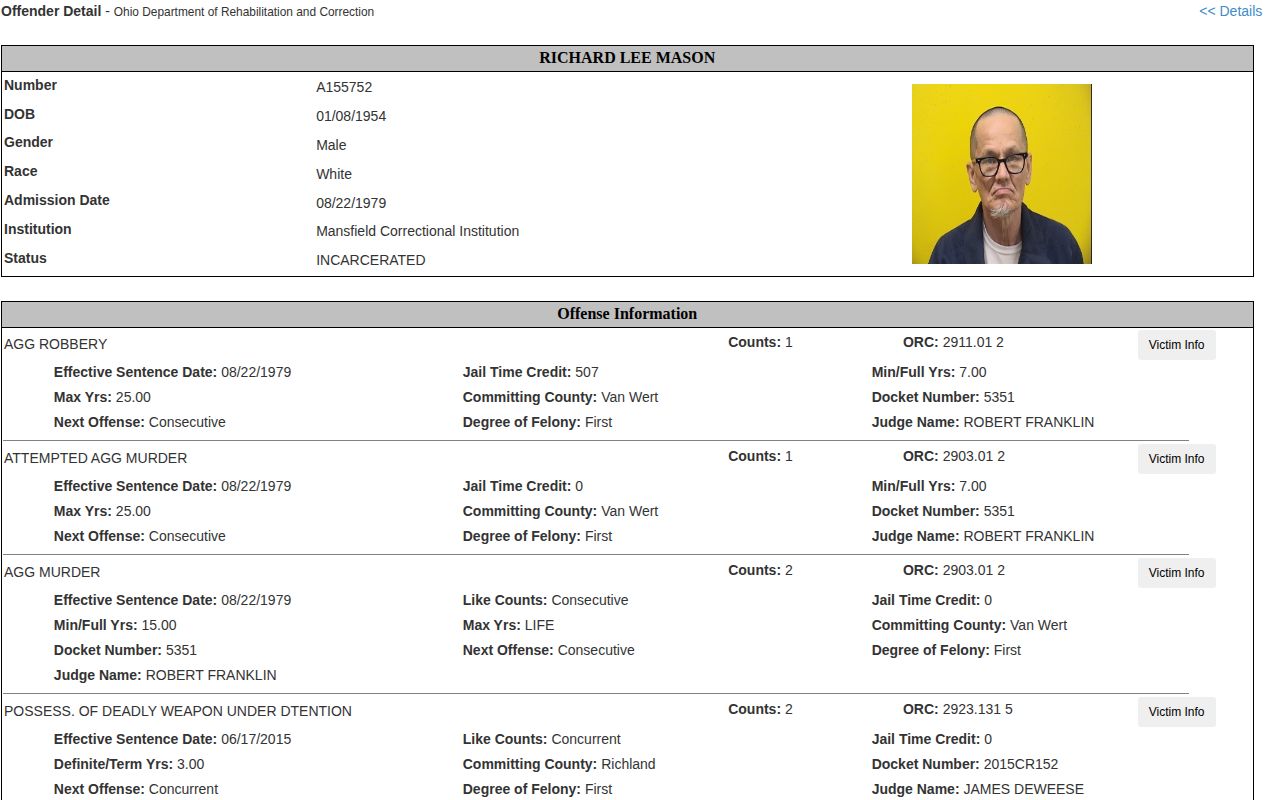
The screenshot is only a dated view. The live person record should be checked again after a hearing or sentence change.
Ohio Credit and Van Wert Release
Ohio has no universal rule that guarantees release after 85 percent of every sentence. The current earned-credit statute, ORC 2967.194, applies to covered confinement on and after April 4, 2024. Subject to its limits and exclusions, an eligible person may provisionally earn one or five days for each completed month of productive participation in approved programming. ODRC may deny or withdraw credit after rule violations through the administrative process.
The statute also permits up to five additional days for completing a second eligible activity. Completion of a listed diploma, equivalency, program, or criterion can earn 90 days or a 10 percent reduction of the stated term, whichever is less. The ordinary participation and completion credits outside that category carry an aggregate ceiling of 15 percent of the stated term.
Good-time rule: A 15 percent ceiling can produce 85 percent shorthand, but it is not an automatic award. Credits must be earned, may be withdrawn, and do not cover every sentence.
Exclusions include terms that other statutes make non-reducible, mandatory terms, death, aggravated murder or murder and related terms, life without parole, and specified sexually oriented sentences. Subtracting 15 percent from a sentence and calling the result a release date would ignore eligibility, participation, exclusions, and later ODRC decisions.
Earlier cases may fall under different rules. ORC 2967.193 governs the earlier earned-credit framework through its transition to the current statute. OAC 5120-2-05 allows up to a 30 percent old-law good-behavior deduction in its covered category, but expressly excludes prison terms for offenses committed on or after July 1, 1996. Old-law good time and current program credit are not the same formula.
The official current-law page is shown in the image below. Its earned-credit text must be read with the person's offense and sentence dates.
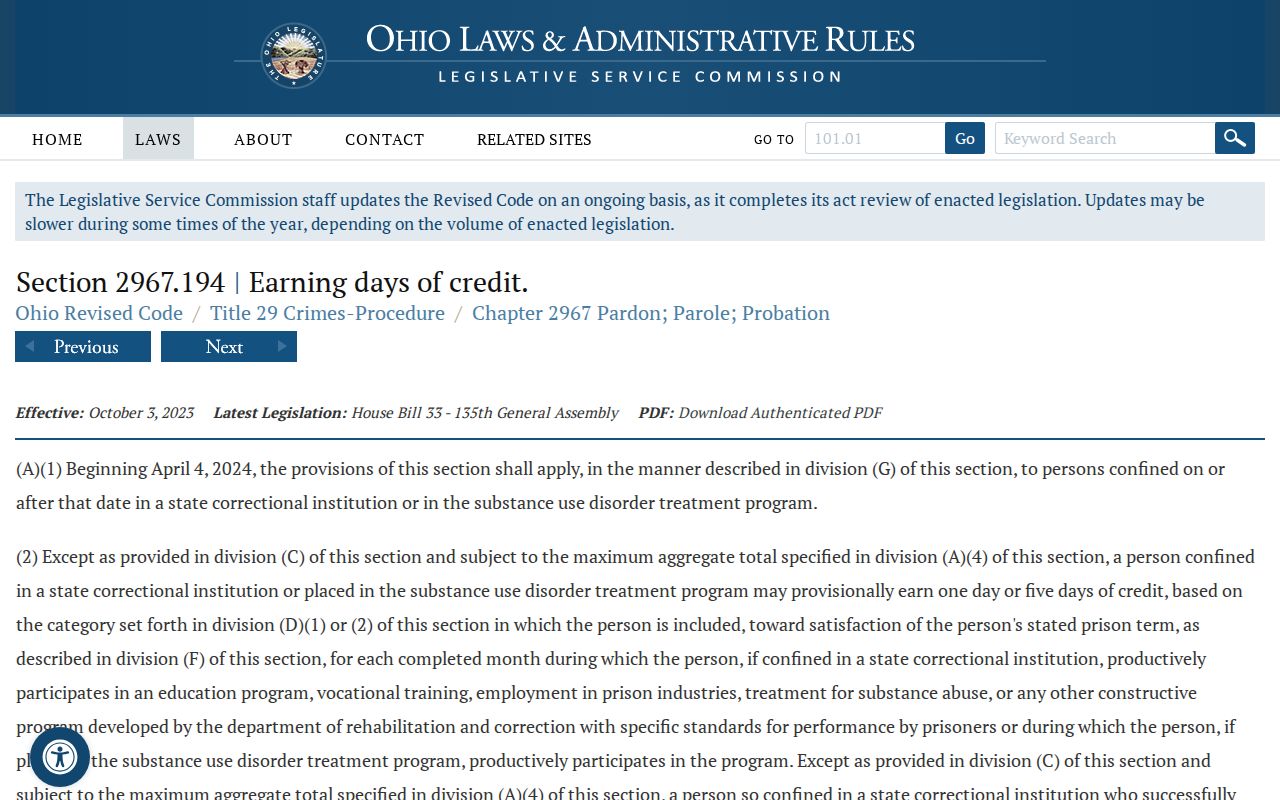
The statute sets the framework, while ODRC applies it to the eligible sentence and maintains the resulting record.
Van Wert Minimum and Maximum Dates
Some Ohio prison terms use a minimum and maximum rather than one fixed number. For covered first- and second-degree felonies committed on or after March 22, 2019, the court selects a minimum and the law supplies a related maximum under ORC 2929.14. ORC 2967.271 presumes release at the minimum or reduced minimum, but ODRC can use the statutory process to rebut that presumption and continue incarceration. Custody cannot continue beyond the maximum under that framework.
A minimum-based estimate can therefore change without the original sentence vanishing. The record should show the aggregate term and status, while the sentencing docket explains the judgment. If a court grants judicial release or modifies the sentence, compare the filed order with the next ODRC update. ODRC itself cautions that online sentencing information may be incomplete.
Parole Board use of PRD has another meaning. Under OAC 5120:1-1-10, the Board may set a projected release date after denial. It can be retained, accelerated, tied to transitional control, or rescinded. It creates no entitlement to release, and a later Status or Release Detail remains necessary.
Why Van Wert Release Dates Change
A date can change because the source is estimating a sentence rather than recording a completed event. It can also change when a court or corrections agency takes a later action. The nature of that action determines which office can confirm it.
| Factor | Possible effect | Record to check |
|---|---|---|
| Earned credit | Eligible credit may reduce the computed term; denial or withdrawal may remove that reduction. | ODRC sentence and credit computation |
| Minimum-maximum procedure | Release at the minimum may be delayed through the statutory rebuttal process. | ODRC status and sentence fields |
| Parole decision | A hearing may approve, deny, continue, or set a later projected date. | Hearing result, official minutes, and later status |
| Judicial release or modification | A later court order may change the custodial term. | Van Wert Common Pleas docket and ODRC update |
| Transfer or hold | Departure from one facility may continue custody with another agency. | Release disposition, destination, and receiving agency record |
| Data timing | A recent court or custody action may not yet appear online. | Originating clerk, sheriff, or ODRC records office |
Never average conflicting dates. A court order may authorize release before physical processing occurs. A custody system may post later still. Record what each timestamp measures, then ask the agency that owns the unresolved event.
Note: Transfer, transitional control, parole, and full discharge describe different legal or custodial states even when each involves leaving a prison building.
Van Wert County Jail Dates
Van Wert's official sheriff website directs current inmates to the Van Wert County Sheriff OH mobile app. The public sources do not document a projected-date field in that app. They also do not establish a county jail good-time formula, recent-release archive, or automatic date calculator. Those gaps should remain gaps.
For a local sentence, use the Van Wert sentencing or commitment order to understand the authorized term. Then ask the Sheriff's Office for the actual booking-and-release transaction, including date, time, release type, and destination where maintained and public. If the court record shows conveyance to ODRC, leaving the county roster means continued state custody, not release into the community.
A person awaiting trial has no sentence end to calculate. Bond, dismissal, a plea, trial, or another court order can change custody. The Municipal Court record system also warns that entries may trail judicial action by at least 24 hours or longer. When timing matters, obtain a verified court copy and direct sheriff confirmation.
Confirm Van Wert Actual Release
Once the projected day arrives, check the responsible agency again. For an Ohio prisoner, Status and Parole or Release Detail are stronger than the old future date. APA Supervision means prison custody ended but state supervision continues. For the county jail, the sheriff's release transaction and the issuing court order should agree on the kind of departure.
Ohio VINE can send custody-event notifications for participating county jails and ODRC, but a transfer alert is not a community-release alert. The separate VINELink Inmate Search explains how to match one person and register for notice. A saved alert is useful evidence of what the service reported, while the underlying agency record remains the better confirmation.
Questions about an ODRC record may be mailed to Ohio Department of Rehabilitation and Correction, Attn: Central Records, P.O. Box 430, Columbus, OH 43216. For a Van Wert jail event, contact the Correctional Facility at 419-238-2464 or direct an identifiable records request to the Sheriff's Office. State the person's full name, approximate dates, and booking or offender number if known.